Ironman 70.3 Alcudia Mallorca Race Report — What the Course Really Demands
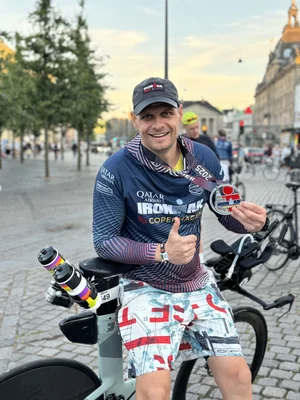
I crossed the line in 6:05:49. And the first thing I thought was: at least I finished.
Let me tell you about Mallorca.
Not the Instagram version — the turquoise water, the perfect finish line photo, the medal held up against a sunset. That version is real, and it happens. But there's a lot that happens before that moment, and if you're thinking about racing Ironman 70.3 Alcudia, you deserve the honest version.
So here it is.
Why Mallorca
I'd been racing in flat countrys — Ironman 70.3 Westfriesland twice, 70.3 Duisburg in Germany, Ironman Copenhagen. A lot of flat. I wanted something different. Something harder.
Mallorca kept coming up. Athletes I respect talked about the bike course like it was something else. The swim in the Bay of Alcúdia, the heat on the run — all of it sounded like a proper test.
I needed a proper test.
For me, that test had a specific shape: climbing and descending on a TT bike. I'd never done it before. No experience with what it feels like to descend at 70km/h+ on a bike that isn't built to be agile, or to grind up a long climb on something less responsive than a road bike.
That was the challenge I came here to face.
So I signed up.
The Days Before
As I wrote about in What a Triathlon Training Camp in Mallorca Actually Does to You, I arrived two weeks before race day. Not to rest — to prepare properly.
Alcúdia is a small town on the north coast of the island. It is genuinely beautiful, which is not always the case with Ironman venues. The race village sits right on the bay. You register, rack your bike, walk the transition — and then you're left with the thing every triathlete knows: too much time to think.
I kept race week simple. The training camp had already done its work.
Monday: One loop of the run course to get familiar with it.
Tuesday: An easy 90-minute ride.
Wednesday: A short shakeout swim in the bay.
Thursday: Rest.
Friday: A 35-minute activation run, then bike check in the afternoon. Food I trusted. Early bed.
And then the weather forecast arrived.
Rain. Storms starting around 11 or 12. Wind. Everything I'd hoped I'd left behind in the Netherlands.
You'll hear athletes at race registration talking about their power targets and nutrition plans like they're preparing for Kona. Tune it out. Focus on your own race.
Race Morning
The alarm goes off before the sun does. That part never changes.
I woke up at 5AM after a good night's sleep. The night before I'd prepared oats with almond milk — in the morning I added peanut butter, banana, and strawberry jam. Simple. Trusted. Nothing new on race day.
By 6AM I was walking to transition — I'd chosen a hotel five minutes away, which I'd do again without hesitation. I put nutrition on the bike, checked tyre pressure, checked the brakes, made sure I was in an easy gear for the start. Checked the bags. Sorted gels into bike and run portions.
Then I put on my wetsuit and walked to the beach, where my wife was waiting.
Standing on that beach before the swim start, looking out at the bay with the mountains of Alcúdia behind it — I remembered exactly why I do this.
The Swim — 36:36 (1.9km)
The Bay of Alcúdia is calm. In my experience, that is not guaranteed in open water racing.
The water was 18 degrees — for me, perfect. Wetsuit legal. The course is a single loop, close to shore, with excellent visibility on the buoys. Sighting is something I work at, and on this course I don't think many athletes struggled with it. The bay does the hard work for you.
Between 7AM and 7:25AM there was an option to warm up in the water. I took it. Always worth it — get the body moving, feel the temperature, settle the nerves before the gun goes. The official start was at 7:35AM. With self-seeding rolling start format, I positioned myself with the 40-minute group, just behind the 35-minute swimmers. That put me at a comfortable pace for the distance and gave me something to swim toward.
A few things worth knowing if it's your first time here:
The start can be crowded. Seed yourself honestly. If you're not a confident swimmer, don't let ego push you to the front. Two minutes lost at the start is nothing compared to arriving at T1 calm and ready to ride.
T1 — 6:39
Long transitions are a feature of this race, not a bug. From swim exit to bike mount is 650 metres — one of the longest transition runs I'm aware of in 70.3 racing. If it takes three minutes longer than you're used to, that is completely normal. Don't panic. Don't rush in a way that costs you later.
Factor it into your target finish time before race day, not during.
The Bike — 3:12:35 (90km, 1000m+ elevation)
This is where the race is decided.
Don't hammer the early flat section just because you can. The climb is coming. Everyone who goes out too hard on the opening kilometres pays for it halfway up Coll de Femenia. I've seen it. I've felt versions of it myself.
Mallorca's 90km course is not Westfriesland. It is not flat. The road winds through some false flats along the way — the kind that keep you motivated, or grind you down depending on how your legs feel — until you reach the top of the climb.
Here's how to understand the Coll de Femenia before you race it:
Sector 1 — From the roundabout to the sign for Coll de Femenia: 7km, averaging 1.5% gradient. Flattish. This is where athletes make the mistake of pushing too hard.
Sector 2 — From the sign to the summit: 7.7km, average grade 5.8%, 433m of elevation gain. This is the climb.
The full ascent — roundabout to the gas station at the top — takes close to an hour depending on your fitness level. Know your FTP. Know your heart rate threshold. Push too far above threshold too often and you will pay on the run. I know this.
At the top sits the famous Repsol petrol station, normally crowded with cyclists on any given weekend. Today, with the roads closed for the race, it was empty. Quieter than it should be. Strange, in the best way.
The climb is also the perfect time to get nutrition dialled in. I took a gel just before the start, then one every 20 minutes on the way up. You're moving slower. It's easier to eat. Use it. I also made a point of finishing my bottle before the climb — there's a feed station at the base where I picked up one litre of electrolytes only, to keep the weight down on the ascent. Another station waits at the top.
The descent from the gas station at Lluc down to Caimari is 8km. Be sensible. A puncture or a crash ends your day, and there were athletes who found out the hard way on the hairpin corners. Most riders around me were measured — respecting the corners, respecting each other. I had the route loaded on my Wahoo, which helped. Knowing what kind of corner was coming meant I could make a proper decision: lean in and carry speed, or touch the brakes and stay safe.
The forecast had promised rain and storms. I kept watching the sky on the descent. The roads were still dry. I won't pretend I wasn't relieved. A wet descent on those hairpins would have been a completely different conversation.
After the descent, the final 35km is flat — and this day, it was windy all the way home. Three years of training in the Netherlands prepared me for exactly this. Some things about living in a flat, windy country pay off.
Arriving back into Alcúdia felt good. The streets were lined with spectators. I gave the top tube a tap. Always do — like thanking a horse that's carried you well.
T2 — 4:06
The legs feel worse at Mallorca T2 than they ever did at Westfriesland. The climb takes something from you that doesn't fully come back until kilometre three of the run. This is normal. Keep moving.
I say it many times to my athletes: nothing good happens in T2, so get out as fast as you can. There's truth in that.
The Run — 2:05:56 (21.1km)
Here is where I made a rookie mistake — and it cost me a better finish.
The course this year was adjusted from previous editions: two loops along the beach and the street above it in Port Alcúdia. Flat, with just one small bridge in between — perfect conditions for a controlled pace strategy.
My goal was to finish the run in 1:45:00. That meant holding 4:55–5:05 min/km, conservative at the start, finishing strong. I left T2, saw my wife at the exit, got the energy boost that only she can give me, and started running to plan.
Then, at kilometre 3, I saw friends cheering along the course. I'd already passed them. With the corner of my left eye I caught them, turned to wave — and walked straight into a city light pole.
Full stop.
Head. Toe. Right knee. I hit it hard and landed on the ground.
It took a few seconds to understand what had just happened. I checked my forehead — there was blood. I stood up and felt the pain in my knee, toe, and head. I will not lie — I was scared.
There were a lot of spectators around. My immediate thought — after checking I could still walk — was that I really hoped no one had filmed it. I did not want to become a TikTok meme titled what not to do in a triathlon. So far, no recording has surfaced. Let's keep it that way.
I continued running. But the pace I had planned was gone.
I adjusted. Slowed the cadence, lowered the pace. From that moment on this was a recovery run — just get to the finish line with as little additional damage as possible. My wife saw me several times on the course. She told me afterwards the smile was gone from my face. That was true. The pain was real. But every time I saw her it pushed me forward.
I crossed the finish line and went straight to the medical tent.
Disappointed in myself. Happy I finished. Knowing that when my body cooled down, the real pain would arrive — and it did. The next three days were a struggle to walk. On day six, writing this, I can move slowly. I have five weeks to recover fully before Ironman Klagenfurt.
The aid stations on this course are frequent enough. Use them. Ice down your neck. Walk through them properly if you need to drink. A 30-second walk at each station is not failure — it is strategy. I have watched athletes blow up in the final 5km because they were too proud to walk for half a minute.
Final Numbers
Swim 36:36
T1 06:39
Bike 3:12:35
T2 04:06
Run 2:05:56
Total 6:05:49
The bike was where I wanted it. The swim was solid. The run tells its own story.
Next up: Ironman Klagenfurt. Five weeks to recover, prepare and we go again.
What I'd Tell You If You're Thinking About This Race
Ironman 70.3 Alcudia is a proper race. Not the hardest 70.3 on the calendar. Not the easiest. It asks a real question of you — particularly on that bike course — and depending on the day, the heat on the run can be brutal. This year, the weather had other ideas.
If you're coming from flat-course racing in the Netherlands, factor in the climbing before you get there. Three or four proper sessions on a climb — or a dedicated simulator if that's what's available — will prepare your legs better than another long flat ride. The Coll de Femenia is manageable if you respect it. It will not forgive you if you don't.
Nutrition matters more here than it does at Westfriesland. Even when the weather is cooler than expected. The climb alone demands it.
Book a hotel within walking distance of transition. Sleep well. Seed your swim honestly. Don't touch that first flat section too hard. And for the love of everything — watch where you're running.
The finish line in Alcúdia is worth it. Just keep your eyes forward.
Thinking about your first triathlon — or ready to race smarter at your next one? I coach athletes at every level, from first-timers to those chasing time goals. Book a free 30-minute consultation and let's talk about your race.
Thinking about your next race?
Book a free 30-minute call — we'll talk through your goals, your schedule, and what it takes to get there.