Why Expats in the Netherlands End Up Training for Ironman (And Why It Makes Complete Sense)
Living in the Netherlands quietly nudges expats toward endurance sports — and sometimes all the way to Ironman. Here's why it happens, and what nobody tells you before you start. I didn't move to the Netherlands to become a triathlete it was work re-location.
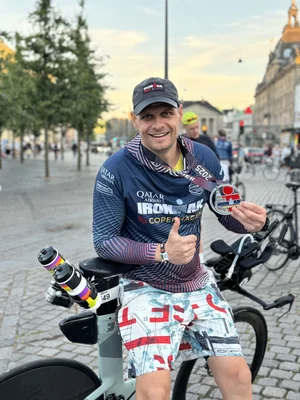
New country, new routines, new version of daily life to figure out. Sport was somewhere in the background — something I'd get around to once things settled. Then April 2022 arrived. I got on a bike for the first time in years. Three years later, I crossed the finish line at Ironman Copenhagen in 11:58:25.I was not the person you'd have predicted that for.
And I've noticed I'm not the only one.
Something about living in the Netherlands quietly pulls people toward endurance sports. And sometimes, all the way to Ironman.
The country does something to you. In most places, sport is something you carve time out for. A separate activity. Scheduled around real life. The Netherlands doesn't work like that. Movement is just how life functions here.
You cycle to work, to the supermarket, to dinner — not as a fitness habit, as the default. Before you've made a single decision about training, you're already more active than you were back home. Then the second thing happens. You notice your colleagues are running half marathons. Someone disappears for six hours on Sunday. A coworker casually mentions they're training for Ironman Copenhagen. Endurance sports stop feeling like something elite athletes do. They start feeling strangely possible. But it's not really about the cycling infrastructure.
Here's what's actually happening underneath all of it. Moving abroad is exciting. It's also quietly destabilising. Your routines vanish. Your social circles reset. You're productive at work — maybe very productive — but life feels narrow.
Triathlon fixes that faster than almost anything else. Training creates rhythm. Suddenly your weeks have shape: swim Tuesday, run Thursday, long ride Sunday. There's progress you can measure. Goals that belong entirely to you. I experienced this myself.
When I started in 2022, I wasn't chasing a finish line. I was chasing structure. Something that was mine. The Ironman came later. The need for belonging came first. I wrote about that whole journey — from zero to Ironman in three years — if you want the full story.
The Dutch environment is genuinely one of the best in Europe to start
The cycling infrastructure means you can ride for hours without fighting traffic. The flat terrain lets beginners build aerobic fitness without getting destroyed by elevation every weekend. Both matter more than people expect. Even the weather — which every athlete here eventually complains about — does something useful.
You will train through horizontal rain, frozen fingers, wind that makes a 30km ride feel like 60. Those sessions build discipline that doesn't depend on perfect conditions. In a full Ironman, you will have bad patches. Dutch winters accidentally teach you how to keep going anyway.
Why Ironman specifically
A marathon is hard. An Ironman is something else. For many expats, it becomes proof. Proof of adaptation. Proof that you can build something meaningful in a country that isn't yours yet. Ambitious people who've relocated for demanding careers often arrive here with a gap they didn't expect — their professional identity is intact, their personal challenge is missing. Ironman fills that gap. Not in a punishing way. In a grounding way. The training slows life down while making it feel bigger at the same time.
The mistakes I made — and see constantly
Excitement is good. Unstructured excitement will end your season before it begins. The pattern: buy the bike, sign up immediately, train hard every day, ignore recovery, get injured by week eight. The other version: train like a full-time athlete while managing a demanding job, travel, relationships, and the low-grade mental load of living somewhere foreign.
You don't need perfect training. You need sustainable training. A good base phase focuses on aerobic volume first, intensity second. Most sessions genuinely easy, a few genuinely hard. One or two quality sessions per week beats five mediocre ones that leave you flat by Friday.
If you want to understand how a full training year actually fits together, this post on building an annual training plan is a good place to start. If you're starting from zero: do less than you think you should in the first two months. Build the habit first. The fitness follows. And if you're wondering whether you can go from couch to race in 12 weeks — here's an honest answer.
The community nobody warns you about
Long rides become social. Race weekends create friendships faster than almost anything else. I've seen people arrive in the Netherlands knowing almost no one and build their closest friendships through triathlon. The sport creates belonging that Amsterdam's social scene — friendly, but not always easy to crack as an expat — sometimes doesn't.
Look for local triathlon clubs. Most have English speakers. Almost all welcome beginners. And if you're looking for a triathlon coach in the Netherlands who coaches in English — that gap is real, and worth knowing about before you start.
The first race most expats in the Netherlands should have on their radar: Ironman 70.3 Westfriesland. It sells out within hours every year for a reason. For a full overview of what's racing in 2026, the Netherlands triathlon race calendar has everything in one place.
If you're at the beginning of this
Maybe you've been here a year. Maybe you've been browsing bikes online wondering if you're being ridiculous. You're not. What helps — and I say this as someone who started from zero and made almost every mistake in year one — is a plan that fits your actual life.
Not a generic app that doesn't know you work 40-hour weeks and need to be functional on Monday morning. If you want to talk through what a realistic first season looks like, a free 30-minute call costs you nothing.
No pressure. Just an honest conversation about what's actually possible.
Thinking about your next race?
Book a free 30-minute call — we'll talk through your goals, your schedule, and what it takes to get there.