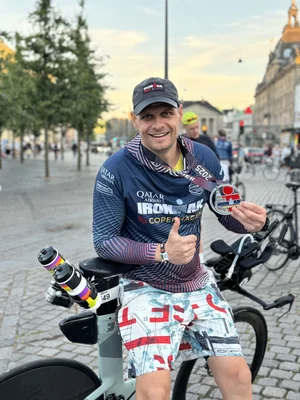
My First Ironman 70.3 — Duisburg 2023 Race Report
I raced this in August 2023 and never wrote it up at the time. Here it is — three years later, with everything I've learned since.
August 6th, 2023. Seven months after I decided to sign up for a 70.3.
I'd been training since January 2023 — from scratch, no real endurance background, just a decision and a plan. I'd done one race in the lead-up: DTS Zandvoort Olympic distance, earlier that summer. A confidence builder, or at least that was the idea.
I was terrified of the run.
Not the swim. Not the 90km on the bike. The run. Specifically, the half marathon that comes after 90km on the bike, when your legs have already decided they've had enough and your brain starts doing the maths on how much is left. I'd never done anything like it. That was the fear I carried to Germany.
The Morning
The sleep wasn't great.
I was convinced I wouldn't hear the alarm. So I set four or five of them. Then I asked my wife to set hers as well. Just in case. When you've trained for seven months for a single day, the idea of sleeping through it is its own kind of nightmare.
Breakfast of champions — oats, peanut butter, almond milk, frozen berries, banana. The same thing I'd eaten before every long session. Race morning is not the time to experiment.
I left early for transition. Checked the bike. Checked the tyres, the brakes, everything in the bags. Then went through the list again. Then again. Ten times, probably — because every time I finished I was convinced I'd forgotten something. That's what nerves do. They make you doubt things you've already checked twice.
The weather was kind. Overcast, around 18–20°C, with the light rain that would arrive later still hours away. For an August race in Germany, this was a gift. No heat to manage. Just cool, quiet racing conditions. I set up transition, tried to look like someone who knew what they were doing, and waited.
The Swim — 39:19
The moment I jumped in, I smiled.
That sounds strange. I was about to start my first 70.3 and I was smiling underwater. But the water in the rowing basin at Duisburg was clear. Genuinely clear. I could see my palms stretched out in front of me.
If you've trained in the Netherlands — lake swims where visibility drops to zero within arm's reach, where you're essentially swimming blind — you understand why this felt like a luxury. A small thing. But it settled something in me immediately.
The course follows the rowing lanes. Straight, well-marked, no navigation guesswork, no searching for the next buoy through murky water. For a first 70.3, this swim is as calm as it gets.
I came out in 39:19. Ahead of where I thought I'd be. The smile stayed.
The Bike — 2:51:50
I'd ridden part of the course a few days before, just to see what I was dealing with. The roads were rougher than I was used to from the Netherlands — not rough enough to be a problem, but enough to notice. During the race I spotted bottles all over the road, shaken loose from other athletes' bikes.
The course itself is fast and rolling. No real climbing — this isn't a race where the elevation breaks you. What it is, is a race where the distance does, if you let it.
My coach had given me a power target. I stayed below it. Deliberately. Some would call that conservative. I'd call it the only sensible strategy for someone whose main goal was to finish, get the medal, and earn the bragging rights. There would be time for racing hard later. That day was about getting across the line.
I kept the nutrition reminders running on my Wahoo — and I followed them strictly. Every prompt, every gel, every bottle. Eat before you're hungry. Drink before you're thirsty. The things you know in training but forget on race day when the adrenaline is doing the thinking.
The last few kilometres into T2, the nerves came back. Not about the bike. About what came next.
The Run — 1:58:06
I stepped off the bike expecting my legs to rebel. They didn't.
I felt good. Genuinely good. The crowd along the run course was loud — properly loud, not polite applause but real noise. The course is three loops, and each loop brings you past the stadium where the finish line lives. Every time, you can hear the announcer. Every time, you can see the finish arch.
That is either motivating or cruel, depending on how you're feeling. For me, it was motivating. Every loop was a reminder that the finish was real, that it was close, that the seven months were about to mean something.
The rain arrived around halfway. Light, refreshing, exactly what tired legs needed. The temperature dropped a few degrees. The roads cooled. Something about running in the rain at kilometre 11 of a half marathon, in a German city, with a crowd cheering — it felt like the race was giving something back.
I was smiling for most of it. I don't entirely know why. Probably because I wasn't dead. Probably because nothing had gone wrong. Probably because the thing I'd been most afraid of for seven months was happening, and it was fine.
The Finish Line
You enter the stadium from the track.
Red carpet. The Ironman logo underneath your feet. The announcer calls your name.
Seven months of early mornings, of oats and peanut butter before the sun came up, of brick sessions and open water swims in Dutch lakes where you can't see your hands — all of it compressed into that single moment on the red carpet.
The hard work paid off. Not in a cliché way. In the specific, physical, deeply personal way that only athletes who've stood on that carpet understand.
What I'd Tell My January Self
Your main fear will be fine. The run after the bike — the thing you're most afraid of — is survivable. More than survivable. What gets people in trouble isn't the distance, it's the ego on the bike. Ride conservative. Run strong.
Follow your nutrition plan like it's a race strategy. Because it is. I set reminders on my Wahoo and followed every single one. That decision carried me through the run.
Recon the course if you can. Riding part of the bike course two days before settled something in my brain. I knew what was coming. Surprises on race day cost energy.
Your first 70.3 is not about the time. It's about learning what this distance actually feels like. That knowledge is only available one way.
One More Thing
I coach athletes targeting their first 70.3 now. When they tell me they're terrified of the run, I tell them I was too.
Then I tell them exactly what to do about it.
If you're building toward your first half Ironman and want a plan built around your actual life — your schedule, your fitness level, your race date — start with a free conversation.
Thinking about your next race?
Book a free 30-minute call — we'll talk through your goals, your schedule, and what it takes to get there.