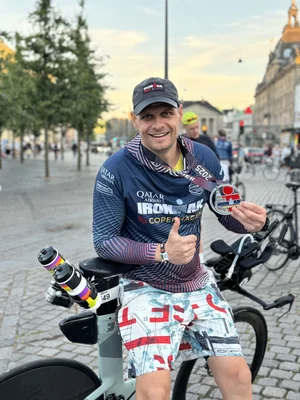
From Zero to Ironman in Three Years — What I Actually Learned
In April 2022, I bought a road bike.I had no cycling experience, no triathlon background, no idea what a brick session was or why anyone would want to do one. I just had a decision — and a very uncomfortable pair of cycling shorts.Three years later, I crossed the finish line at Ironman Copenhagen 2025 in 11:58:25.
I'm not telling you that to impress you. I'm telling you that because I want you to understand something important: I was the beginner. Completely. Embarrassingly. Genuinely.
And if I can go from a first bike ride to a full Ironman — while working full-time, living abroad, and figuring it all out with no previous endurance background — so can you.
This is the story of how it actually happened. Not the highlights reel. The real version.
It Started With One Decision
I moved to the Netherlands from Austria in 2019 and in 2017 from Slovenia to Austria. By 2022, I was five years into life abroad — comfortable, settled, but quietly aware that something was missing. The physical challenge. The sense of working towards something hard.
I didn't know how to swim properly. I hadn't run more than a normal 10-15K. I had never sat on a road bike for longer than a commute.
But I signed up for an half Ironman triathlon anyway, knowing that one day I would lie to finish full Ironman.
That decision — before I had any idea what I was doing — turned out to be the most important one I made. Because the goal came first. The training had to catch up.
Year One: Learning Not to Drown (Literally and Figuratively)
The first six months were humbling. Swimming was the hardest thing. I could get from one end of the pool to the other, but with no technique and a lot of panic. Open water felt like a different sport entirely. My first lake swim — I stopped, treaded water, and seriously considered whether I'd made a terrible mistake.I didn't stop. Quite early after signing up I started looking for a coach. Best decision of my life. Found one that supported me on my journey and gave me confidence boost. That’s all I needed at the begining.
On the bike, I was slow. I had no idea about pacing, power, cadence. I was just turning the pedals and hoping.
Running was fine. Running I understood.I was playing handball as a kid / teenager. But running after cycling — that I didn't understand. The first time I stepped off a bike and tried to run, my legs felt like they belonged to someone else.
What I did right in year one: I kept going. I didn't try to optimise everything at once. I showed up, session after session, and I trusted that the fitness would come if I just stayed consistent.
In June 2023, I finished the Olympic Triathlon at DTS Zandvoort. It wasn't fast. It wasn't elegant. But I crossed that finish line, and I remembered exactly why I started. With struggles on the run (heat, pacing) I kept thinking what awaits me in few months on my first 70.3 Ironman Duisburg, Germany. 1.9km swim. 90km bike. 21.1km run. I had just finished my first Olympic triathlon — 1.5km swim, 40km bike, 10km run. Doubling (roughly) felt like a leap I wasn't ready for.
I trained for it anyway.
Coach built a structured plan for the whole season. Periodised weeks. A real taper. Specific nutrition strategy on the bike. I started taking the details seriously — not because I was obsessing, but because at 70.3 distance, the details start to matter in a way they don't at Olympic distance. You can survive Olympic distance on grit. You cannot survive 70.3 on grit alone. I finished my first Ironman 70.3 in 5 hours 46 minutes and 36 seconds. Not fast. But strong — and in control from start to finish.Something I never imagined became a reality.
That was the moment I understood what structured training actually felt like. The difference between showing up and hoping versus having a plan and executing it.
Year Two: 70.3 & Marathon?
In 2024 I decided I want to continue on my path of becoming an Ironman. Signed up for Ironman 70.3 Westfriesland 2024 and signing up for Marathon, to test the distance.
I went back to Westfriesland in 2025 and finished it again — this time knowing exactly what to expect, including the wind on the back half of the bike, the lonely stretch before the run turns back toward the city, and the electric moment when the finish line comes into view.
In between, I ran the KPMG Marathon in 2024 and 2025, and the TCS Amsterdam Marathon. And in the summer of 2025, I swam 6km across a lake in Aalsmeer — something the April 2022 version of me would have considered impossible.
The Ironman Decision
By late 2024, I knew what the next step was. I had known for a while.
Ironman 140.6. The full distance. 3.8km swim. 180km bike. 42.2km run.
I signed up for Copenhagen.
The training was the hardest thing I've done. Not every session — plenty of sessions were fine, even enjoyable. But the volume. The cumulative fatigue. The weeks where you're tired before you start and more tired when you finish. The long rides that go for four, five, six hours and leave you wondering whether you over-committed.
Here's what I learned in those months:
Consistency beats heroics. The athletes who show up every day for six months are faster on race day than the athletes who do three epic weeks and then collapse into a hole. Training for a full Ironman is a project in sustainability, not a test of who can suffer the most.
Nutrition is a discipline. I learned this the hard way on long training rides before I learned it the easier way on race day. You cannot outwork a nutrition mistake at this distance. Fuel early, fuel often, and never try anything new on race day.
The mental game starts before the start line. The hardest part of race day isn't the last 10km of the run. It's the six months of training when no one is watching, when the alarm goes off at 5:30am and it's raining and you go anyway.
Copenhagen: Race Day
Race morning in Copenhagen was calm. Cold, but calm.
I remember standing at the swim start and feeling something I hadn't expected: readiness. Not confidence, exactly. But a quiet sense that I had done the work. That whatever happened over the next twelve hours, I had earned my place at that start line. My loved ones were with me on the start and that is something I need the most on this kind of races. Support from my familly.
The swim was fine. The bike was long — 180km always is — but I paced it well, didn't go out too hard, kept eating and drinking on a strict schedule. By kilometre 120 I was tired but in control.
The run was where it gets honest.
A full marathon at the end of an Ironman is not a race. It's a negotiation. Your legs are there. Your lungs are there. Your mind is the variable. At kilometre 30, everything hurts and the only question is whether you want the finish badly enough to keep moving.
I did.I crossed the finish line in 11:58:25.
I had set a goal of finishing under 12 hours. I made it by 105 seconds.
The announcer said my name. The finish chute was lined with people and my looking at the faces of my loved ones brougt tears in my eyes. And I thought about a bike I bought in April 2022 with idea where it could take me.
What Three Years Actually Taught Me
Start before you're ready. The athletes who wait until conditions are perfect never start. You don't need the right gear, the right fitness level, or the right amount of free time. You need a goal and a willingness to begin.
Structure is freedom. This sounds like a contradiction. It isn't. A well-built training plan doesn't restrict you — it takes the daily decision-making off the table and lets you just train. Without structure, every session becomes a negotiation with yourself.
The beginner phase is valuable. I used to rush through it mentally, always thinking about what I'd be able to do in a year. Now I coach athletes and I see the beginner phase differently. The first 6 months of any endurance sport are when you build the habits, the mindset, and the movement patterns that everything else sits on top of. Don't rush it.
Having someone in your corner changes things. I did a lot of my early training alone, figuring things out by trial and error. The progress I made when I finally trained with structure and support was faster, more sustainable, and more enjoyable. Not because the sessions got easier — but because every session had a purpose.
You are not too late, too slow, or too old. I started at 39 with no endurance background. I know athletes who started later. I know athletes who were slower. The finish line doesn't check your age group.
Why I Coach
People sometimes ask me why I coach beginners specifically.
The honest answer: because I remember exactly what it feels like to be one.
I remember not knowing how to ask questions without feeling stupid. I remember training hard and not knowing if what I was doing was right.
That's what I try to give the athletes I coach. Not perfection. Not shortcuts. Just clarity, structure, and the confidence that they're on the right path.
If you're at the beginning of your endurance journey — or restarting after a break — I want you to know something:
I've been exactly where you are. And it goes somewhere incredible.
If you're training for your first triathlon or marathon and you want a coach who has genuinely been the beginner himself and is still loving the sport and racing— book a free consultation here. No pressure. Just an honest conversation about your goals.
Thinking about your next race?
Book a free 30-minute call — we'll talk through your goals, your schedule, and what it takes to get there.