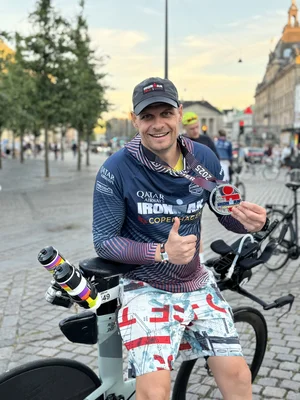
Ironman 70.3 Poreč — my slowest run off the bike. And I'm happy with it.
2:09:48.
That's my half marathon at Ironman 70.3 Poreč on 18 October 2026. My slowest run off the bike — ever. Slower than Duisburg, slower than both Westfrieslands, slower than Alcudia earlier this year.
And I crossed the finish line on the Poreč seafront smiling.
Let me explain why. Because if you're coming back from an injury — or from years away from sport — this is the race report I'd want you to read.
Swim 38:06 - 1.9 km · chip time
Bike 2:45:32 - 90 km · 32.7 km/h
Run 2:09:48 - 21.1 km · 6:12/km
Knee Held
The race I wasn't sure I'd start
To understand Poreč, you need to go back to May. Ironman 70.3 Alcudia, Mallorca.
Kilometre 3 of the run. My friends were cheering on the side of the course. I turned to wave at them — and walked straight into a city light pole.
Head. Toe. Right knee. I hit it hard and went down.
I got up with blood on my forehead and a knee that hurt with every step. The 1:45 half marathon I'd planned was gone. I switched to survival mode, ran 2:05:56 to the finish, and went straight to the medical tent. The next three days, I could barely walk. I wrote the whole story in my Ironman 70.3 Alcudia race report — and yes, I can laugh about it now. Mostly.
A light pole doesn't care how well you trained.
What followed was not a normal season. That right knee forced me into a long rehab block — and when I say long, I mean my running log was literally named "Rehab Run #013", "#014", "#015". Rehab Run #015 was on 10 September. Five weeks before Poreč.
I get it if you're in that place right now. You look at the calendar. You look at the knee. You do the maths and it doesn't add up.
I didn't jump back into long runs. I built back slowly, mostly on flat roads around Aalsmeer and on Zwift, where I could control everything. My last real test was a 15 km tempo run on 4 October — two weeks before Poreč. I called it exactly what it was on Strava: "Last longer knee test before Poreč."
It passed. So I raced.
Why Poreč
I was born in Slovenia. Istria is practically next door — Poreč is a short drive from the Slovenian border. Racing there felt like racing at home, even after living abroad since 2017.
It's also one of the last 70.3s of the European season. Mid-October. If your summer gets wrecked by injury, work, or life, Poreč gives you a second chance at the year.
Preparing for hills when you live in the flattest country in Europe
Here's the honest problem for anyone training in the Netherlands: the Poreč bike course is not flat - it’s rolling. My Strava shows 561 metres of climbing over 90 km. Around Kudelstaart, I'd need a week to collect that.
So I did three things:
I rode the course virtually — twice. I uploaded IM 70.3 Poreč route gpx into Rouvy. I rode it on 22 September and 8 October. You learn where the “climbs” come and how long they last, so nothing surprises you on race day.
I arrived a week early. I based myself in Istria from 11 October and rode “hills” with Eduardo — not hard, just enough to remind my legs what gradients feel like.
I recced the course and tested the water. On 14 October we rode the course out to the highway section and back. On 16 October we did a sea swim in Poreč — with Eduardo, Aleš and a few jellyfish :). Better to meet them on Friday than at the swim start.
The swim — 38:06
Sea swim, chip time 38:06 for 1.9 km. Not my fastest. Not my slowest.
The test swim two days before did its job. I knew the water, I knew the temperature, and I knew the jellyfish existed. No surprises means no panic — and no panic is worth more than any drill.
The bike — controlled on purpose
The morning started cool — 13.7 °C when I rolled out of T1, warming to around 20 °C by the end. Light wind. Honestly, ideal conditions.
The biggest effort on the course is the Porečka climb: 2.5 km and about 80 metres of gain. I rode it in 7:27 at 231 W. After that, the long highway stretch — fast, steady, where you either settle in or burn matches you'll miss later.
My numbers for the full 90 km: 178 W average, heart rate 142 bpm, 32.7 km/h. The last 15 km I sat at 148 W and a heart rate of 136. Easy legs heading into T2.
Or so I thought.
If you want the framework behind how I pace the bike, it's all in a simple 70.3 pacing framework for age-group athletes.
The run — where my own mistake caught up with me
The run course follows the coast from Poreč old town towards Zelena Laguna and back. Pretty. Mostly flat, with a few short kicks — 134 metres of elevation over the half marathon.
The first 10 km felt good. Every single kilometre between 5:37 and 6:08. My 10 km split was 58:42. The knee was quiet but the cramps came.
Here's what the data shows, and it's worth knowing if this ever happens to you: my heart rate actually dropped — from around 152 bpm in the first half to 145 bpm through kilometres 14 to 16. That's not your engine failing. That's your muscles refusing. You can't push through cramps with fitness you already have.
And the cause was simple. My nutrition. My mistake.
Let me be honest — you'd think I'd have learned this by now. I wrote about race nutrition after my first 70.3 in Duisburg back in 2023. Three years and a full Ironman later, it still got me. The long rehab block meant fewer long brick sessions, and fewer chances to rehearse race-day fuelling at race-day intensity. That gap showed up at kilometre 11. I use Precision Fuel and Hydration Electrolytes, but this race did not have them on the run course - also not possible to buy in the Ironman shop at registration - they only had ISO that for me was too sweet and unknow, so didn’t want to risk gut issues and cramp issues combined.
What I'd tell you if Poreč is your race
Train the “climbs”, even from the Netherlands. Ride the course on ROUVY or Zwift, and do seated climbing efforts of 6–8 minutes. That's roughly how long the Porečka climb takes most age-groupers.
Get there early and test the sea. One relaxed swim two days before the race removes most of the swim-start nerves.
Respect the highway section. It's fast and it's tempting. Stay at your planned power and save the legs for the run.
Rehearse your nutrition in your last long bricks. Same products, same timing, same intensity. If your build was interrupted, this is the first thing that slips — don't let it.
Start the run slower than you think you need to. The coastline is beautiful, and the first 5 km will feel easy. They're supposed to.
The real result
I started from zero in April 2022. No triathlon background. No marathon history. Since then: Ironman 70.3 Duisburg, Westfriesland twice, Ironman Copenhagen in 11:58:25, Alcudia in Mallorca this spring — and now Poreč.
Poreč isn't my fastest race on that list. It might be the one I'm proudest of.
Because a few months ago I was counting rehab runs. On 18 October I ran 21 km after 90 km on the bike, and my knee held. The cramps were my fault, and I can fix that.
The knee was the question. The finish line was the answer.
If you're coming back — from injury, from a break, from years away — you don't need to be fast. You need a plan that respects where your body actually is. That's exactly how I coach. Have a look at my coaching plans, or read the full story of how I went from zero to Ironman.
Coming back from injury or a long break, and want to do it properly this time? Book a free 30-minute call. No hard sell — just an honest conversation about your race and what it would take to get you there.
Thinking about your next race?
Book a free 30-minute call — we'll talk through your goals, your schedule, and what it takes to get there.