Your First Triathlon in the Netherlands: How to Actually Get Started
You've decided to do it. You've probably already registered — for DTS Zandvoort, for a sprint somewhere near Amsterdam, for whatever race made you say yes, this one. Now you need to know what comes next. In the right order. Without the noise.
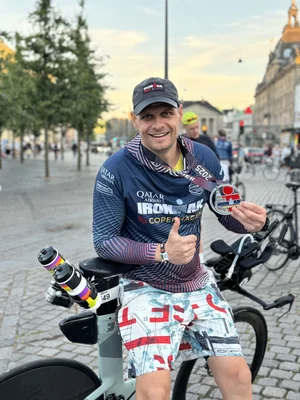
I get it. I stood exactly where you're standing now. In April 2022 I hadn't swum a lap, cycled further than the supermarket, or run more than a few kilometres without stopping. Three years later I finished Ironman Copenhagen in 11:58:25. Not because I was talented. Because I figured out what actually mattered, in what order, and stopped guessing.
This is that order — for the Netherlands specifically.
Choosing Your First Race
Sprint or Olympic distance? Here's the honest comparison, not the marketing version.
A sprint triathlon — roughly 750m swim, 20km bike, 5km run — is the right first race for almost everyone reading this. It's long enough to be a real achievement and short enough that one bad session in training doesn't wreck your whole build. Olympic distance (1.5km swim, 40km bike, 10km run) isn't off the table for a first race — but the preparation is genuinely different, not just "sprint plus more." You need more aerobic base, more time on your feet, and more patience in the build. Go in knowing that, and plan your training accordingly.
The Netherlands makes this easy. Flat terrain, a dense race calendar, and events built for exactly this level. I cover the full 2026 calendar with coaching notes on every Dutch triathlon event this year.
For a genuine first race, I point most of my beginner athletes toward the Dutch Triathlon Series. Four events — Zandvoort, HLMRMEER, Ouderkerk, and Bosbaan — all offering sprint and Olympic distances, and all with a dedicated Rookie Race wave built specifically for first-timers. Unlike Ironman-branded races, they don't sell out within hours of registration opening. That means less pressure to commit before you're sure, and more room to pick a date that actually fits your build. Once you've done a DTS race and know you want more, Westfriesland or DTS Zandvoort's Olympic distance are natural next steps.
The Equipment You Actually Need
You do not need an aero helmet, a tri suit with a brand-name price tag, or carbon anything for your first sprint. Here's what actually matters:
A bike that fits you and has working brakes — road, hybrid, or gravel is fine
Goggles that don't leak (test this in the pool, not on race morning)
A pair of trainers you've already run in, never new ones on race day
A basic wetsuit if your race has an open-water swim under 20°C — most Dutch lake swims will
A race belt for your number, so you're not pinning a bib to a wet tri top in T1
That's it. Everything else can wait until you know you're staying in the sport.
How to Structure Your First 12–16 Weeks
A good build focuses on aerobic base first, race-specific intensity from around week 10 onwards. That's not a rule I invented — it's the same structure I use with every First Finish athlete I coach, and it's the same one that got me through my own first races without injury.
In practice, that means: three to four sessions a week across the three disciplines, most of them easy enough that you could hold a conversation, with one slightly harder session per discipline once you're past the halfway point. If that sounds too easy at first, good — that's the point. I've written the full 12-week structure here, including exactly what a realistic week looks like if you're starting from zero.
Start slower than you think you need to. Every injury I've seen in a first-time athlete came from ignoring this one line.
The Swim: The Leg Everyone Fears
Let me be honest — my first open-water swim was a mess. I panicked in the first thirty seconds, forgot how to breathe properly, and finished convinced I'd made a terrible decision. I hadn't. I'd just never practised sighting, never swum in a wetsuit before, and never swum near other people.
Pool swimming and open-water swimming are not the same sport. If your race has an open-water leg, you need at least three or four open-water sessions before race day — not zero. Sighting frequency depends on how well you swim straight. If you already track a straight line in the pool, sighting every six to eight strokes is plenty. Most beginners drift more than they realise, so sight more often than that at first — every three or four strokes — until you've actually tested how straight your line is in open water. Practise starting in a crowd too. That fear mostly disappears the second time, not the first.
The Dutch Advantage
If you're training in the Netherlands, you're training in one of the best places in Europe to do it. Flat terrain means your bike sessions build fitness, not just survive hills. A strong cycling culture means drivers are used to you being on the road. And the race calendar is dense enough that you're never more than a few weeks from a local event to test yourself against.
If your first year builds toward something bigger — Ironman 70.3 Westfriesland is the natural next step for a lot of the athletes I coach, and I've raced it twice myself. Here's what that course actually demands, for when you're ready to look further ahead.
What to Expect on Race Day
Nobody tells you this part clearly enough, so here it is:
Registration: usually the evening before or early race morning — check your specific race, they vary
Transition setup: arrive with enough time to rack your bike, lay out your gear, and walk the transition route twice so it's not a surprise under pressure
The start: wave or mass start depending on the race — controlled chaos either way, and completely normal
T1 (swim to bike): don't rush it. A calm 90 seconds beats a frantic 60
T2 (bike to run): your legs will feel wrong for the first 400m of the run. That's normal. It passes
The finish: slower than you imagined, better than you expected. Almost always both
Once you've actually got a race booked, here are five lessons every first-timer learns on race day — the things I'd tell you to expect, so you're not learning them the hard way mid-race.
When to Consider a Coach
Honest answer, not a pitch: you don't need a coach to finish your first triathlon. Plenty of people do it well with a free plan and some discipline.
Where a coach helps is when you don't want to guess — when you want someone checking that your training is actually building toward race day, not just filling a calendar, and when you want a plan built around your actual life instead of a generic template. I've written honestly about what coaching costs and whether it's worth it — worth a read before you decide either way.
I've been the beginner. I've been the one asking these exact questions. If someone you know is standing where you're standing right now, that's exactly who I coach.
Thinking about your next race?
Book a free 30-minute call — we'll talk through your goals, your schedule, and what it takes to get there.