What Your First Triathlon Teaches You Before (A) Race Day
Every athlete I coach comes back from their first race with the same look on their face. Somewhere between proud and slightly stunned. They finished. And they learned more in three hours than in three months of training.
A shorter race — often an Olympic distance triathlon — booked deliberately as a dress rehearsal before the big one. A 70.3. The distance isn't the point. The lessons are.
Here are the five that come up again and again. If you've got a test race coming up, read this first — it'll save you from learning some of it the hard way.
1. You'll give away more space in the swim than you need to
Almost every first-timer does this. You line up, the gun goes, and you assume everyone around you is faster. So you drift wide, hold back, and swim defensively for the first few hundred metres — burning energy without gaining anything.
Then the field spreads out. Suddenly there's room. And that's when people swim their best pace of the whole race.
The fix is simple: trust your training, not your nerves. You know your pace. Hold your line from the first stroke — don't wait for the field to make room for you.
2. Your transition setup will fail you in a small, annoying way
It's rarely the big things that go wrong in T1 and T2. It's the small ones. A spare tube with nowhere good to mount it. A shoe that's tucked in wrong. A gel you forgot was in your back pocket.
Athletes lose 90 seconds in transition over something that would've taken thirty seconds to fix in training. Every piece of kit needs a rehearsed home — practised, not assumed. If you can't confidently change a flat with your eyes closed, that's not a race-day problem. That's a two-weeks-before problem.
3. You'll surge every time you pass someone — and pay for it later
This one catches almost everyone, including me. You come up behind someone on the bike, and instead of passing at your pace, you kick a gear harder than you need to. It feels good for ten seconds. Then your heart rate spikes, and you're recovering from an effort you didn't need to make.
Do this ten times over a bike leg and it adds up to real fatigue on the run. Pace is not something you defend. It's something you hold — even when someone's in your way.
4. Heat-weather nutrition only works if you commit to the schedule
A bottle every 30 minutes. A gel every 20. It sounds excessive until you're two hours into a hot race and everyone who skipped a feed is walking. The athletes who stick to their nutrition schedule — even when they don't feel like it yet — are the ones still running strong at kilometre 15.
Stomach issues late in a race are almost always a pacing or fuelling-ratio problem, not a bad-luck problem. If it happens near the finish every time, that's data — not a fluke.
5. A negative split feels impossible until you've actually run one
Most athletes go out too fast on the run, because the bike is finally over and the legs feel free. It rarely pays off. The athletes who hold back early — even when it feels frustratingly slow — are the ones with a kick left in the final two kilometres.
A negative split isn't a talent. It's a decision you make in the first kilometre, not the last. Get it right once, and you'll never want to race any other way again.
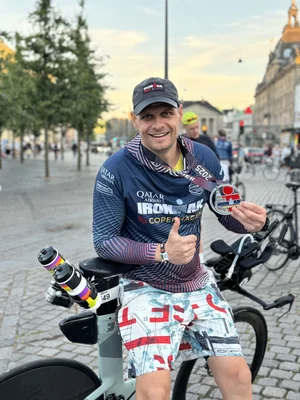
I started from zero in April 2022 — no triathlon background, no marathon history. My own first Olympic triathlon was at DTS Zandvoort in 2023, used exactly the way I'd recommend to any athlete: as a dress rehearsal, not a goal in itself. Three years later: Ironman Copenhagen, 11:58:25.
Every one of these five lessons still shows up — in my own racing, and in the athletes I coach. That's exactly why I build a test race into every athlete's build towards a bigger goal. It's cheaper to learn these lessons in an Olympic distance race than in the middle of your first 70.3.
Thinking about your next race?
Book a free 30-minute call — we'll talk through your goals, your schedule, and what it takes to get there.