Your first triathlon — the complete race-day checklist
Race-day gear, transition setup, nutrition basics, and a week-before countdown. Everything you actually need — nothing you don't.
You've registered. The race is in the calendar. And now a very specific kind of panic has set in — the "what on earth do I actually need to bring?" kind.
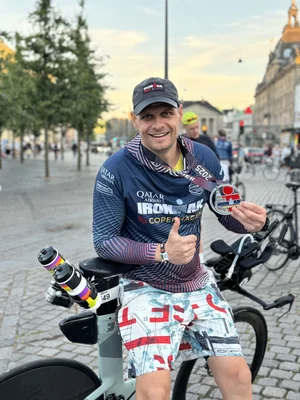
I've been there. Before my first triathlon at DTS Zandvoort in 2023, I spent three evenings reading gear lists online, each one slightly different, each one somehow managing to be both overwhelming and incomplete at the same time.
So I made my own. And I've refined it through every race since — Ironman 70.3 Westfriesland (twice), Ironman Copenhagen, TCS Amsterdam Marathon, and more. This is the list I actually use. It works whether you're racing a sprint triathlon at a local lake or toeing the line at a 70.3 for the first time.
Use this in the week before your race. Print it out. Tick it off. Then scroll down for the night-before and race-morning sections too.
Swim gear
What to pack
Wetsuit (approved for the race distance — check the water temperature rules)
Swim goggles (plus a backup pair in your kit bag — this is not optional)
Swim cap — the race will provide one, but bring your own in case it's thin latex
Anti-chafe lubricant (apply to neck, wrists, and ankles before putting on wetsuit)
Ear plugs if you use them in open water
Microfibre towel — for transition, not the finish line
On wetsuits: Check the official race website the week before for confirmed water temperature and wetsuit rules — these vary by race and by year. When in doubt, bring your wetsuit. A wetsuit you don't use costs you nothing. A cold swim without one costs you everything.
Bike gear
On the bike
Helmet (certified, fits properly — try it on before race week)
Cycling shoes and cleats — check cleats are tight and lubricated
Bike computer (charged the night before)
Two water bottles filled — one with plain water, one with electrolytes
Bike nutrition: gels, bars, or chews in a reachable pocket or aero bar bag
Sunglasses — wind, sun, and insects on the bike course make these essential
Repair essentials
2 spare inner tubes (same size as your tires - valve suitable for your dip-wheels)
CO2 cartridges or hand pump
Tyre levers
Multi-tool
Race number holder or safety pins for the bike leg
On pacing the bike: The most common beginner mistake — going out too hard because the first 20km feels easy. Pacing matters more than aerodynamics. If you blow up on the bike, the run becomes a suffer-fest. Start conservatively. You can always push harder in the second half. You can't undo a blown-out first half.
Run gear
What to pack
Running shoes (your trained-in shoes — race day is not the day for new)
Race belt with your race number
Running socks (optional — many athletes skip in sprint races, essential in longer ones)
Hat or visor if the course is exposed
Run nutrition (gels, chews — tested in training)
Elastic laces if you've trained with them — saves time in T2
Transition setup
Transition is the fourth discipline. Most beginners spend 3–5 minutes in T1 and T2 when it should take under 2. The fix is simple: lay everything out in the exact order you'll use it, and practise the sequence at home at least once before race day.
T1 (Swim → Bike)
Towel laid flat on the ground as your base if allowed, otherwise in bike bag
Helmet placed open-side up with sunglasses inside
Cycling shoes placed in front of or on the bike (clip-ins pre-attached to pedals saves 30 seconds) if allowed
Bike nutrition clipped in and ready
Wetsuit removal: practise this at home. Learn to peel from shoulders, step out fast.
T2 (Bike → Run)
Running shoes positioned open and facing you
Race belt with number
Hat or visor if needed — put it on as you run
Leave everything else. Don't stop to rearrange gear.
Nutrition — the basics
Nutrition is where most beginners either overcomplicate or ignore. Here's the simple version that works.
Race morning (2–3 hours before start)
Eat what you've eaten before long training sessions — not something new
Aim for 60–90g of carbohydrates : oats, toast, banana, rice cakes
500ml of water with breakfast
Coffee if you normally drink it — race day is not the day to change habits
No high-fibre foods, no dairy if your stomach is sensitive
During the race
Sprint/Olympic: sip at aid stations, gel(‘s) on the bike if it's longer than 45 min
70.3 and above: 60–120g carbs per hour on the bike - what ever you have practiced, sip every 15 minutes
Start eating earlier than you think you need to — don't wait until you're hungry
Only use gels or nutrition you've tested in training. Race day is not an experiment.
The week-before countdown
7 days
Check your bike: Shift through every gear. Squeeze both brakes. Check tyre pressure. Oil the chain. If something feels wrong, fix it now — not the night before.
5 days
Pack your kit bag: Use this checklist. Lay everything on the floor and photograph it. Mentally run through the race and ask: what am I missing?
3 days
Study the race course: Download the GPX file. Look at the transition zone layout on the race website. Know where you rack your bike, where the exits are, where the aid stations are on the run.
1 day
Prep everything the night before: Lay out your kit. Charge your GPS/watch/gears. Fill your water bottles. Set two alarms. Eat your normal dinner — nothing rich or new. Sleep matters more than one extra training session.
Race morning
Arrive early: Transition zones close before the race starts — often 30–45 minutes before your wave. Check your race guide for the exact cut-off. Arrive with at least 60 minutes to spare. Set up unhurried. Walk the transition zone. Know where you enter from the swim, where you exit to the bike, where you come back in from the bike, where you leave for the run. Breathe.
One thing that matters more than all of this
I've given you the full gear list. But honestly? The athletes who struggle most at their first race don't struggle because they forgot a gel or packed the wrong socks.
They struggle because they didn't have a plan. They went out too fast on the swim and panicked. They rode the bike on feel instead of effort, blew up at kilometre 15, and walked the last 3km of the run.
A race-day kit is 10% of the equation. A training plan is the other 90%.
Check out the coaching plans at Peak Within, or read about how I went from zero to Ironman in three years. And if you want to talk through what makes sense for your race and your life, the first conversation is free and there's no pressure — just an honest chat about fit.
Thinking about your next race?
Book a free 30-minute call — we'll talk through your goals, your schedule, and what it takes to get there.