How to Increase Running Volume Safely
What I Check Before I Answer
Almost every athlete I coach asks this question at some point. Usually around week four or five, when the legs are feeling good, the plan is clicking, and the temptation to do more is suddenly very loud.
"Can I add more running this week?"
The answer is almost never just yes or no. It depends on four things — and most athletes only think about one of them.
Here's exactly what I look at before I respond.
Factor 1 — Current weekly volume, and how long you've held it
The first number I check is simple: how many kilometres are you running per week right now? The second question is more important: how long have you been at that level?
A lot of returning athletes — especially people coming back after years away from structured training — underestimate how long the body needs to adapt to a given load before it's ready for more. Your cardiovascular system catches up fast — it adapts to a new load within days. Your tendons and connective tissue take much longer. Research by Bohm et al. found that meaningful tendon adaptation requires a minimum of 12 weeks of consistent loading stimulus. That gap between cardiovascular fitness and structural readiness is where running injuries happen.
If you've been at 35km per week for three weeks, you're probably not ready for 40.
The rule I follow: hold a new volume level for at least three weeks before increasing it. Not two. Three. This is non-negotiable in the first twelve weeks of a build.
Factor 2 — Recent injury history and current soreness signals
I ask two questions here. First: have you had any running-related injuries in the last six months? Second: what does your body feel like right now — not during a run, but the morning after?
Morning-after soreness is one of the most honest signals the body gives you. A bit of muscular fatigue in the legs after a hard session? Fine. That's expected. But achilles tightness that doesn't clear by 10am, shin tenderness on palpation, or knee ache that lingers into the afternoon — those are warning signs, not inconveniences to run through.
I had an athlete who flagged calf tightness early — before it became a problem. We immediately dropped intensity and duration, had him checked and cleared by a physio, and continued training without a single forced break. No missed weeks. No setback. Just a small adjustment made at the right moment. That's what catching it early looks like. Most athletes don't — they wait until the body makes the decision for them.
If there's any ongoing soreness that's not purely muscular, the answer to "can I add more?" is no — until we've figured out what the signal means.
Factor 3 — Total training load across all three sports
This is the factor most athletes don't think about. They ask about running volume in isolation. But if you're a triathlete, running volume doesn't exist in isolation.
The question isn't "can I handle more running?" It's "can I handle more running on top of what I'm already doing in the pool and on the bike?"
I track total training stress across all three disciplines. When a heavy bike week coincides with a planned run increase, those two things don't just add up — they compound. Recovery capacity is finite. And running, particularly at the intensities required for triathlon race prep, is the most injury-prone of the three disciplines.
A week with 6 hours on the bike and a 10km run increase is a different proposition to a week with 4 hours on the bike and the same run increase. Same numbers. Different stress. I always look at the full picture before I move anything.
Factor 4 — Where we are in the training cycle
The fourth factor is context. Where are we in the training plan?
Base phase — the first eight to twelve weeks of a build — is about building aerobic capacity and structural durability. Volume increases are small and controlled. The goal is consistency, not load.
Build phase — roughly weeks ten to eighteen for a half-iron build — is where volume peaks and intensity increases. This is where you can afford slightly more aggressive progressions, because the aerobic base is already established.
Peak and taper — the final four to six weeks before a race — are not the time to add anything. The fitness is built. The job now is arriving at the start line with fresh legs, not one more long run you didn't need.
Where you are in the cycle changes what "safe" looks like. A 15% run increase in week six of a base build is a different risk to the same increase in week twelve of a build phase.
The 10% rule — when it applies, and when it doesn't
You've probably heard it: don't increase weekly mileage by more than 10% from one week to the next. It's a useful rule of thumb. But it's often too conservative for athletes who are under-trained relative to their goal, and occasionally not conservative enough for athletes returning from injury.
The science backs this up. Sports scientist Tim Gabbett's acute:chronic workload ratio research shows that athletes whose current week's load exceeds their four-week average by more than 30% face significantly elevated injury risk — regardless of how fit they feel.
Here's how I actually use it.
For athletes new to structured run training — like someone doing their first sprint triathlon — the 10% rule is a ceiling, not a target. I often aim for 5–8% increases in the early base phase, because the structural adaptation lag is longest when you're starting from scratch.
For experienced athletes returning to sport after a break, I use a modified version: hold volume flat for two to three weeks first, then apply 10% increases once there's a confirmed injury-free baseline.
And for athletes well into a build — already at 80–90% of their goal weekly volume — I sometimes increase by less than 10% but add a mid-week quality session. Volume stays almost flat. Quality load increases. It's a different kind of progressive overload, and it's often safer at that stage.
What a safe 4-week run progression actually looks like
Here's a concrete example. Athlete profile: returning runner, 42 years old, building toward a marathon. Currently running 30km per week. Three weeks at that volume. No injury signals. Moderate bike and swim load alongside. We're in week six of a sixteen-week build.
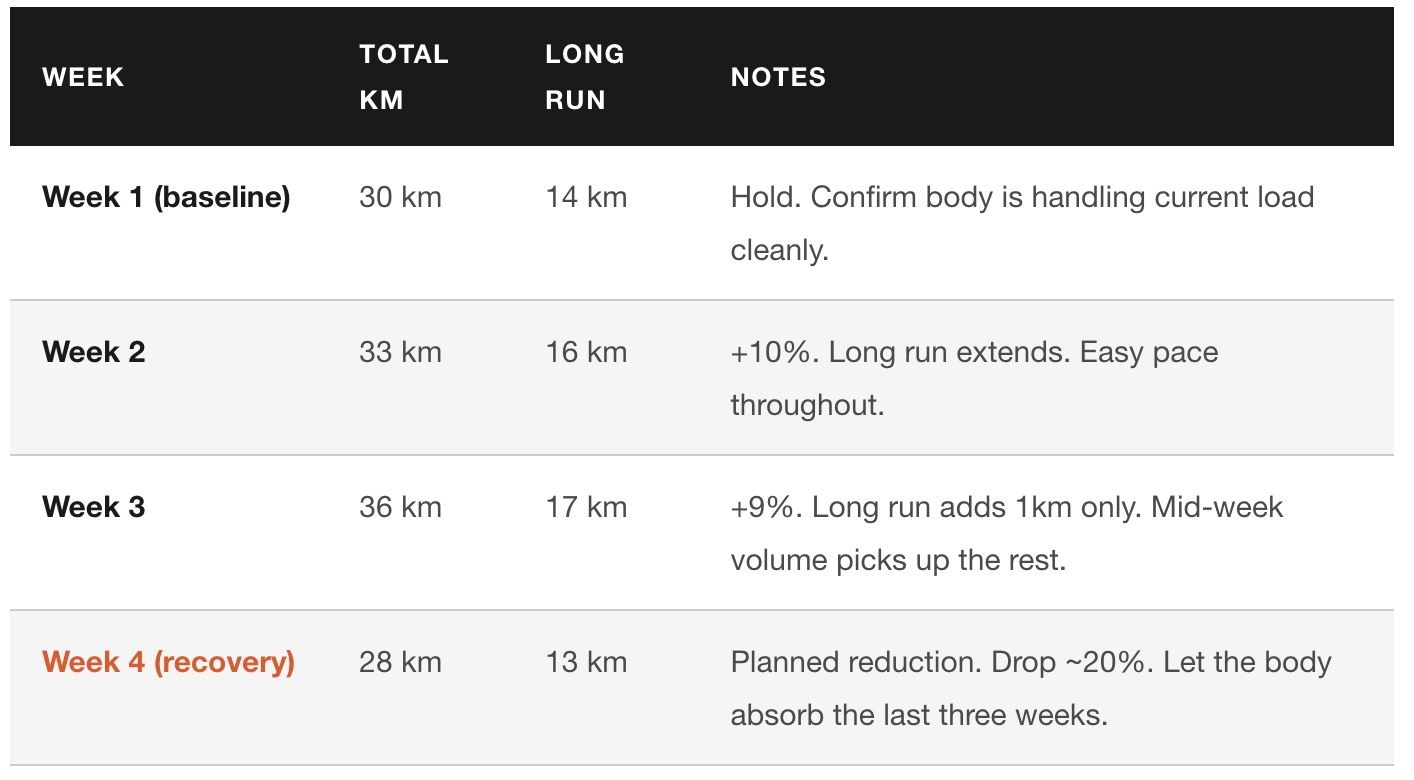
Weekly example of athlete in build phase
Notice week four. The recovery week is not optional. It's not something you skip when you're feeling good. That's exactly when skipping it feels most tempting — and most dangerous. The fitness gains from weeks two and three happen during week four, when the body is absorbing the load, not adding to it.
After week four, we check in on all four factors again before planning the next block.
What this tells you about how I coach
The question "can I add more running?" sounds simple. But the answer touches every part of how a training plan is built — and how I adjust it week by week based on what your body is actually telling me.
I'm not cautious for the sake of it. I want you running more. I want you arriving at your race with more kilometres in your legs, more confidence in your pace, more certainty that the plan worked.
But I've seen what happens when athletes rush this. They lose four weeks to a stress reaction they could have prevented with one easy week. They arrive at the start line undertrained because they were injured for six weeks mid-build. They push through signals that were asking them to slow down — and the body answers eventually, on its own terms.
The fastest way to run more is to never stop running. And the way to never stop running is to earn each increase before you take it.
So when you ask me "can I add more running?" — now you know what I'm checking before I answer.
Thinking about your next race?
Book a free 30-minute call — we'll talk through your goals, your schedule, and what it takes to get there.