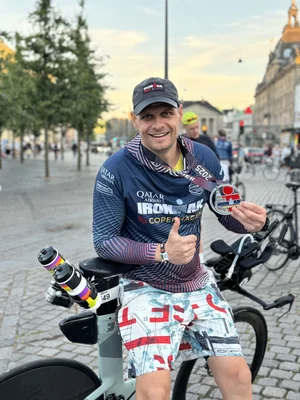
When to Stop: What Injury Really Teaches You About Training
I won't be on the start line on Ironman Klagenfurt Austria this summer.
That sentence took me a while to write. Ironman Klagenfurt was on my calendar marked as A race of this year. The training was building. And then an injury changed everything — and I had to make the call that every endurance athlete dreads: pull out, or push through.
I chose to pull out.
This post isn't really about me, though. It's about what happens to you when injury strikes mid-build. The decisions you face. The ones nobody prepares you for. And the mindset shift that separates athletes who come back stronger from those who compound the damage trying to fight through it.
If you want the full story of how it started you can read my Ironman 70.3 Alcudia Mallorca race report . That race taught me something important.
The moment every injured athlete faces
You're mid-block. Fitness is coming. The race is circled on the calendar. And something hurts.
Maybe it's been nagging for a week. Maybe it came on sharp and sudden. Either way, your brain does the same thing: it starts negotiating.
It's probably nothing. I'll train through it. I can't afford to miss this week. I've already paid for the race entry.
I know that voice. I've heard it myself. And as a coach, I hear it also from athletes. The problem isn't that athletes want to train. The problem is that they think stopping feels like failure — when actually, it's the smarter play.
Stopping is a decision. Pushing through is also a decision. One of them usually adds 6–12 weeks to your recovery. And it's rarely the one where you rest.
The four signals that tell you health comes first
There's no universal rule that says "if X, then stop." Bodies are different. Injuries are different. But over three years of training — and coaching athletes through their own setbacks — I've seen four clear signals that tell you the answer isn't "train through it."
1. The pain changes your movement pattern
Pain you can feel but run through without altering your gait, stroke, or pedal stroke is one thing. Pain that makes you compensate — that changes how you move to protect the area — is something else entirely.
When you compensate, you load something else. A hip injury becomes a knee problem. A foot issue becomes a calf problem. You don't outrun compensation. You just spread the damage.
If you're moving differently because of the pain, stop and get it assessed. That's not opinion. That's how the body works.
2. The pain is present at rest, not just during exercise
Exercise-induced discomfort that clears within an hour of finishing is often manageable with load modification. Pain that is still there the next morning — or that wakes you up at night — is your body sending a louder message.
Rest pain is the body signalling that it cannot recover fast enough to keep up with what you're asking of it. At that point, training is not building fitness. It's building damage.
3. You've already tried "a few easy days" and it hasn't improved
Most athletes try this first. Take two or three easy days, see if it calms down, then pick back up. That's often a reasonable starting point for minor niggles.
But if you've done that cycle — rest, try again, pain returns — two or three times, the easy days are not enough. You're managing the symptom, not fixing the cause. And every time you reload before the tissue is ready, you extend the overall timeline.
Three rounds of "it's almost better" without actual improvement means you need a physio, not another easy week.
4. You are training in fear, not in confidence
This one is harder to measure. But it's real.
When every session starts with "let's see how this feels" — when you're constantly monitoring, constantly bracing, constantly negotiating with the pain — you're not training properly. You're not hitting the stimulus you need. And the mental load of training scared is exhausting in a way that doesn't show up in your training log.
Confident athletes train better. Injured athletes training in fear just accumulate fatigue without the adaptation. If that's your current reality, the race prep you're doing isn't as effective as you think it is.
The conversation nobody wants to have: should you start the race?
Here's where it gets personal. You've done all the right things. You've rested. You've seen a physio. The injury is improving — but you're not fully right. And race day is three weeks out.
Do you start?
My honest answer, as a coach: it depends on what "not fully right" means, and what finishing the race will cost you.
The race will always be there. Your body has to last you a lifetime. One entry fee is not worth an injury that rules out the next 12 months.
If you start a race injured, you are not racing — you are surviving. You are asking a damaged structure to hold together for 70.3 or 140.6 miles. Sometimes it does. Often it doesn't. And when it doesn't, the damage done in those final kilometres can be the hardest to come back from — because you pushed past every signal your body gave you.
I made the call on Klagenfurt before it got to that point. Not because I gave up. Because I understand what it costs to start a race you're not ready for — and what it costs to lose six months afterwards.
What actually happens when you return to training too soon
I want to be specific here, because vague warnings don't help anyone.
When you return before tissue is healed, a few things happen. First, the weakened tissue gets loaded again. Depending on the injury, that either extends the inflammatory phase or creates scar tissue that forms under stress.
Second, your nervous system is still in a protective state. Neuromuscular patterns change around injury. Power output drops. Coordination is subtly off. You feel "almost fine" but you're running on a compensated pattern.
Third — and this is the one athletes underestimate — the psychological reset doesn't happen. You never fully got to be injured, recover, and come back clear. You just trained at a lower quality for longer, and you're still carrying the worry into every session.
Coming back too soon doesn't shorten recovery. It extends it. Almost every time.
How to return to training the right way
This is where the coach in me wants to give you something concrete. Because "rest and then come back" is not a plan. It's a hope. Here's what an actual return-to-training process looks like.
Step 1: Get a clear diagnosis first
You cannot plan a return without knowing what you're returning from. This means seeing a sports physio or doctor — not a GP who tells you to rest and take ibuprofen, but someone who works with athletes and understands training load.
Ask three specific questions at your appointment:
What is the injury and what is the likely timeline?
What can I still do that won't stress the injured tissue?
What are the signs that I'm progressing versus regressing?
Those three answers give you a framework. Everything else flows from that.
Step 2: Maintain what you can, don't mourn what you can't
Most injuries don't require total rest. A runner with a foot stress reaction can usually still swim and cycle. A swimmer with a shoulder issue can still run and strength train.
Identify what you can do and do it consistently. This keeps fitness from sliding as far as you fear, and — more importantly — it keeps your routine and your mental state intact. Athletes who go from full training to nothing tend to spiral. Athletes who stay active in alternative disciplines stay sharp.
Step 3: Return with graduated load, not full sessions
The biggest mistake in returning to training: the first session back feels good, so you do a full session. Then you're back to square one.
Return with load that is 30–40% of your pre-injury volume in the affected discipline. That might feel embarrassingly easy. It should. The goal of the first week back is not fitness — it's confirming the tissue responds without reaction. Only increase load when the previous level has been tolerated for at least 3–4 consecutive sessions without symptom recurrence.
Step 4: Rebuild your confidence, not just your fitness
This step is invisible in training logs but it matters. After injury, many athletes carry a background anxiety into every session. They're waiting for the pain to return. That anxiety affects pacing, effort, and how much you enjoy the sport you love.
Address it deliberately. After a few sessions at reduced load with no symptoms, name that to yourself: this is working. Build the evidence base that your body is responding. Don't just track the physical — track the confidence.
Some athletes find it helpful to work through this with their coach. Others find that a structured return plan — one with clear milestones — gives them the certainty their nervous system needs. Whatever works for you, treat the mental recovery as part of the training, not a byproduct of it.
The thing I want you to take from this
I started from zero in April 2022. No triathlon background. No marathon history. I finished Ironman Copenhagen in 11:58:25. Ironman 70.3 Duisburg, two Ironman 70.3 Westfriesland and Ironman 70.3 Mallorca finishes. A 6km open water swim. I've built those results on one principle above everything else: you cannot be consistent if you keep getting injured.
Missing Ironman Klagenfurt is frustrating. I won't pretend otherwise. But the alternative — starting that race compromised, finishing it more damaged, and losing the rest of the season — is not a trade I'm willing to make.
The athletes who progress year on year are not the ones who are mentally the toughest about training through pain. They are the ones who are honest about their bodies. Who treat recovery as part of the process. Who understand that the race is not the finish line — the season after it is.
Health over ego. Every time. It's the only way to keep doing this for years.
If you're working through an injury right now and you're not sure how to structure a return — or whether to start a race you're not fully right for — I'm happy to talk through it. No generic advice. Just an honest conversation about your situation and what the right next step looks like.
Thinking about your next race?
Book a free 30-minute call — we'll talk through your goals, your schedule, and what it takes to get there.