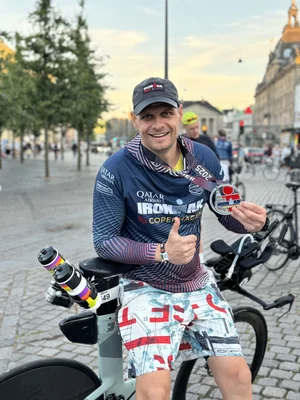
Ironman Copenhagen 2025
In August 2025 I crossed the finish line at Ironman Copenhagen 140.6 in 11:58:25 — my first full Ironman, three years after picking up a road bike for the first time. Here's how race day actually went.
The morning
Race morning in Copenhagen has a specific feeling. You're up before the city. The streets are quiet. Your kit is laid out, your nutrition is packed, and there's nothing left to prepare — which somehow makes it worse.
I'd visualised this day hundreds of times during training. Now it was actually here and the only thing left was to execute.
Transition check. Wetsuit on. Walk to the start.
SWIM - 3.8km | 1:15:00
The swim takes place in a salty lagoon in the heart of Copenhagen. Water temperature on race morning: 18.3°C. Cold enough to be glad you're wearing a wetsuit. The lagoon is calm and the course is almost completely straight — which matters more than most people realise.
Sighting is one of the biggest hidden time-wasters in open water. On a crooked course, a poor sighter can add hundreds of metres over 3.8km. Copenhagen's layout removes that variable almost entirely. For anyone nervous about their first long open water swim, it's about as kind as a full Ironman swim gets.
I came out of the water in 1:15:00. Happy with that. More importantly, I came out confident. Legs working. Head clear. Ready for what came next.
BIKE - 180km | 05:43:00
The Copenhagen bike course has around 1,500 metres of elevation — but believe me it’s fast! Rolling hills, smooth tarmac, and on race day, a consistent scale 4 wind that made itself known early.
I'd planned for 5:30:00. I finished in 5:46:00.
The wind was the difference. On a calmer day the disc wheel is a no-brainer — and I still think it was the right call. But the wind added friction that compounded over 180km in a way that's hard to fully model in training.
The honest truth about the bike in a full Ironman: you are not racing it. You are managing it. Every watt you overcook on the bike is a minute — sometimes more — you pay back on the run. I knew this going in. I tried to hold myself back in the first 60km when everything felt easy and the temptation to push was real.
By the time I rolled into T2, my legs were tired but not destroyed. That was the goal.
RUN - 42.2km | The hard part
The run course through Copenhagen's city centre is phenomenal. Crowds, cobblestones, atmosphere. The kind of course that carries you through the first half whether you're ready or not.
I started the run with one fear: my back. On long runs, especially after a long bike, I get lower back pain that builds gradually and eventually dominates everything. I felt it early. I managed it. It never became the crisis I'd braced for.
What became the crisis was km 20.
The stomach went. Completely. I'd been taking gels every 30-40 minutes on the bike and into the run — standard protocol. By km 20 my body had simply had enough. The thought of another gel was unbearable.
So I threw them all in the bin at an aid station.
All of them.
And picked up crackers and bananas instead.
That decision — improvised, slightly desperate — saved my race. The solid food settled my stomach within a kilometre. I kept moving. I kept eating. I finished.
It's also a lesson I now give every athlete I coach who's preparing for long distance: practise your race nutrition obsessively in training. Not just what you plan to eat — but what you'll do when that plan falls apart. Because at some point, it will.
The finish line - 11:58:25.
Two minutes inside my twelve-hour goal.
I'd set two goals for Copenhagen: finish, and go sub-12. I achieved both.
Standing on that finish line, three years after my first bike ride, I didn't feel relief exactly. It was more like confirmation. That the training had been right. That the decision to start in 2022 had been right. That the early mornings and the Dutch winter rides and every session that felt pointless had been adding up to something real.
You don't cross an Ironman finish line and become a different person. But you do confirm something about the person you already were.
What I'd do differently
Start the run nutrition adjustment earlier. Don't wait until the stomach revolts — test real food from km 10 onwards in training and on race day
Build more buffer on the bike. 5:30 was optimistic given the wind forecast. 5:40–5:45 with fresher legs for the run is the smarter split
More brick sessions in the final 8 weeks. The bike-to-run transition is its own discipline and it deserves dedicated training
If you're thinking about your first full Ironman
Start earlier than you think you need to. A proper annual training plan — with phases, not just weeks of training — makes the difference between arriving at the start line ready and arriving hoping.
Get your nutrition dialled in training, not on race day. TrainingPeaks is where I track every athlete's load and recovery — the data tells you things your legs don't always admit.
And if you're an expat in the Netherlands wondering whether a full Ironman is realistic — read this. I started exactly where you are.
If you want to talk through what your first Ironman build could look like, a free 30-minute call costs you nothing. No pitch. Just an honest conversation about what's actually possible for your schedule, your fitness level, and your timeline.
That finish line is real. And it's more achievable than it looks from where you're standing right now.
Thinking about your next race?
Book a free 30-minute call — we'll talk through your goals, your schedule, and what it takes to get there.